Hybrid Lifting Stations for Critical Infrastructure
The Design Problem
In critical infrastructure, wastewater systems represent a single point of failure that's routinely underspecified. While electrical resilience, HVAC redundancy, and fire protection receive rigorous design attention, drainage is often treated as a compliance exercise rather than a resilience requirement.
This creates risk exposure:
- Operational downtime when lifting stations fail
- Emergency maintenance access during live operations
- Flood damage to plant rooms and electrical infrastructure
- Regulatory non-compliance and hygiene incidents
- Unexpected lifecycle costs from high-frequency pump cycling
The issue is compounded by deteriorating sewer network capacity across the UK and Ireland. Backwater surcharge is no longer an edge case - it's a design load condition, particularly for facilities with below-ground discharge points.
Design question: If the external network cannot guarantee discharge capacity, how should the building protect itself?
Conventional Lifting Station Performance Profile
Standard pumped drainage systems solve the discharge problem but introduce operational characteristics that conflict with critical site requirements:
Energy and wear patterns:
- Continuous or high-frequency pump cycling as baseline operation
- Elevated energy consumption regardless of actual need
- Accelerated mechanical wear on impellers, seals, and motors
- Shortened mean time between maintenance interventions
Operational dependencies:
- Full reliance on electrical uptime for routine drainage
- Noise and vibration in occupied or sensitive areas
- Limited operational visibility between alarm events
- Reactive maintenance model rather than predictive
These systems function, but they're optimised for discharge capability rather than operational efficiency or resilience.
Hybrid System Architecture: Design Logic
Hybrid lifting stations invert the operational logic. Instead of pumping as the default mode, they use gravity discharge during normal conditions and activate pumping only when external network conditions require it.
Core principle: Don't pump unless backwater conditions demand it.
Operational Modes
Mode 1: Gravity drainage (normal operation)
- Wastewater discharges via gravity under typical sewer conditions
- No pump operation, no energy consumption, no mechanical wear
- System operates passively with minimal intervention requirement
Mode 2: Backwater protection (exception handling)
- Automatic isolation via motorised non-return elements when backwater detected
- Pump activation to discharge above surcharge level
- Level monitoring and alarm integration for operational visibility
- Return to gravity mode when network conditions normalise
This approach delivers two outcomes:
- Reduced operational loading on mechanical systems (lower energy, less wear, longer service intervals)
- Inherent resilience through operational redundancy (gravity + pumping capability)
Kessel EcoLift XL: Technical Specification Overview
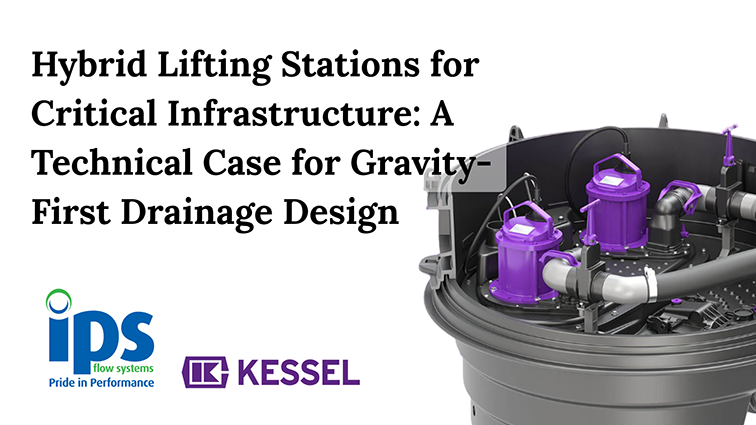
EcoLift XL is a pre-engineered hybrid lifting station designed for commercial buildings, multi-family residential, and critical infrastructure applications.
Performance specifications:
Pump options:
- SPF 1400-S3 EcoXL: 1.4 kW pump capacity
- SPF 1500-S1: 1.5 kW pump capacity
- SPF 3000-S3 EcoXL: 3.0 kW pump capacity
- SPF 4500-S3 EcoXL: 4.5 kW pump capacity (maximum performance class)
Electrical configurations:
- Single-phase: 230V options available (1.4 kW pumps)
- Three-phase: 400V options available (1.5-4.5 kW pumps)
- Single or twin pump configurations for redundancy
Backwater protection systems:
- Mechanical closure flaps (2x) for passive backwater protection
- Single motor-driven closure system for grey water applications
- Dual motor-driven closure systems for black water/foul drainage applications
- Positive isolation between building drainage and sewer network during backwater events
Control and monitoring:
- Comfort Plus control unit (standard on all configurations)
- Pneumatic level measurement system
- Optical probe alarm sensor for high-level detection
- BMS-compatible alarm outputs for remote monitoring
- Clear failure mode indication for maintenance planning
Installation configurations:
Free-standing (exposed) installation:
- Suitable for plant rooms, service areas, or below loading docks
- Direct access for service and inspection
- Can be installed downstream of grease separators
Underground chamber installation:
- Modular engineering chamber upper sections available
- Groundwater-resistant to 3,000mm depth
- Service shaft modules provide above-grade access
- Suitable for installation beneath floor slabs, car parks, or external areas
Low installation height variant:
- Optimised for applications with restricted headroom
- Maintains full functional specification in reduced envelope
- Available across all pump performance classes
Construction and materials:
- Polymer construction for corrosion resistance
- Modular design for simplified installation and future replacement
- Pre-assembled and factory-tested before delivery
Serviceability:
- Guide rail system for pump removal without confined space entry
- Minimal planned maintenance requirement during gravity operation
- Standard submersible pump components for parts availability
- Service access designed for single-person maintenance operations where possible
Application Suitability
EcoLift XL is specified across sectors where drainage failure creates operational or safety consequences:
- Data centres: Zero-tolerance for unplanned downtime, continuous operation requirements
- Healthcare facilities: Infection control and continuous operation requirements
- Industrial/manufacturing: Process continuity and contamination risk management
- Commercial/mixed-use: Below-ground discharge with variable load profiles, multi-family residential buildings
- Public infrastructure: High-reliability expectations and budget constraints
- Downstream of grease separators: Can be installed after separation systems in commercial kitchens
Specific installation scenarios documented:
- Underground car park floor slab installations
- Plant room installations downstream of grease separators
- Below loading docks and ramps with external access shafts
- Multi-family residential buildings with below-ground drainage points
- Concrete embedment installations where chamber access is required
Common design drivers:
- Below-ground drainage points with backwater exposure
- High or variable flow demand profiles requiring 1.4-4.5 kW pump capacity
- Uptime-critical operations where drainage failure = service interruption
- Sites requiring reduced maintenance intervention frequency
- Projects with lifecycle cost scrutiny and sustainability targets
Sustainability credentials: The EcoLift XL hybrid approach has been recognised by the German Society for Sustainable Building (DGNB). At the DGNB Sustainability Challenge, the Ecolift range was ranked in the top 3 product innovations for its energy efficiency compared to conventional lifting stations.
The gravity-first operating principle delivers approximately 90% reduction in energy consumption compared to continuous-pumping conventional systems, while simultaneously improving operational reliability.
Design Integration: What Specifiers Need to Establish Early
Hybrid systems perform best when incorporated during drainage strategy development, not deferred to package selection.
Critical design inputs:
1. Backwater risk assessment
- Local sewer network surcharge history and frequency
- Invert levels relative to worst-case external water level
- Number and location of below-ground discharge points
- Regulatory or adoption authority requirements
2. Flow characterisation
- Peak discharge rate (L/s) and duration
- Daily/weekly flow profile (continuous vs. intermittent)
- Simultaneous discharge assumptions (fixture units, diversity factors)
- Future capacity headroom requirements
3. Resilience criteria
- Acceptable downtime for drainage system maintenance
- Alarm response time expectations
- Backup power requirements (if any)
- Failure mode tolerance (fail-safe vs. fail-operational)
4. Integration requirements
- Alarm routing (local, remote, both)
- Monitoring data requirements (simple alarm vs. operational telemetry)
- Cybersecurity considerations for networked systems
Common specification errors to avoid:
- Specifying lifting stations without confirming backwater risk or design storm return periods
- Undersizing based on average flow without considering peak discharge events
- Failing to coordinate alarm outputs with BMS or building monitoring strategy
- Not establishing maintenance access requirements during design stage
- Selecting systems based solely on capital cost without lifecycle cost modelling
Lifecycle Performance Comparison
Conventional lifting station:
- Pumps operate continuously or on high-frequency cycling
- Energy cost accumulates regardless of actual backwater risk
- Maintenance intervals driven by pump runtime hours (typically every 6-12 months)
- Higher parts replacement frequency over 20-year design life
- Full electrical dependency for baseline drainage operation
Hybrid lifting station (EcoLift XL):
- Pumps operate only during backwater events (potentially <5% of operating hours)
- Energy consumption reduced by approximately 90% compared to conventional systems
- Maintenance intervals extended due to reduced mechanical runtime (12-18+ month intervals possible)
- Lower whole-life cost despite potentially higher capital outlay
- Graceful degradation: gravity operation continues even if pump control fails
Example scenario: A commercial building with infrequent backwater events (10-20 occurrences/year, 2-4 hours duration each) may see:
- 95%+ reduction in pump runtime vs. conventional continuously-pumped system
- Annual energy consumption reduced from continuous operation to ~40-80 hours/year
- Corresponding reduction in energy costs and mechanical wear
- Extended service intervals from 6-month to 12-18 month cycles based on actual runtime
- Reduced reactive callout risk and associated emergency labour costs
Quantified sustainability benefits:
- 90% energy consumption reduction (verified by DGNB assessment)
- Reduced carbon footprint over facility operational life
- Lower total cost of ownership when evaluated over 15-20 year lifecycle
- Improved operational reliability through reduced mechanical duty cycles
The Engineering Case
Hybrid lifting stations represent a shift from reactive drainage design to proactive resilience planning.
Design benefits:
- Operational efficiency: gravity-first logic reduces energy and wear
- Resilience: automatic backwater protection without manual intervention
- Maintainability: reduced mechanical runtime extends service life
- Lifecycle value: lower total cost of ownership over facility lifespan
Risk reduction:
- Backwater protection without continuous pumping dependency
- Graceful degradation (gravity operation continues if pump control fails)
- Reduced emergency callout exposure
- Better operational visibility through integrated monitoring
For critical infrastructure, the question isn't whether wastewater systems matter—it's whether they're designed with the same rigour as other mission-critical services.
Hybrid lifting technology provides a clear technical pathway to that standard.
Technical Support and Design Tools
Kessel SmartSelect Design Assistant: Kessel provides a web-based design tool (SmartSelect) that allows specifiers to configure and size hybrid lifting stations based on project-specific parameters:
- Step-by-step guidance through wastewater type, delivery head, and flow resistance
- Automated product selection based on design criteria
- Technical calculations and performance verification
- Reduces preliminary design time and supports accurate specification
Technical specification support: For project-specific guidance on hybrid lifting station specification, flow calculations, system configuration, and installation coordination, contact IPS Flow Systems for technical assistance specific to UK and Ireland applications.