
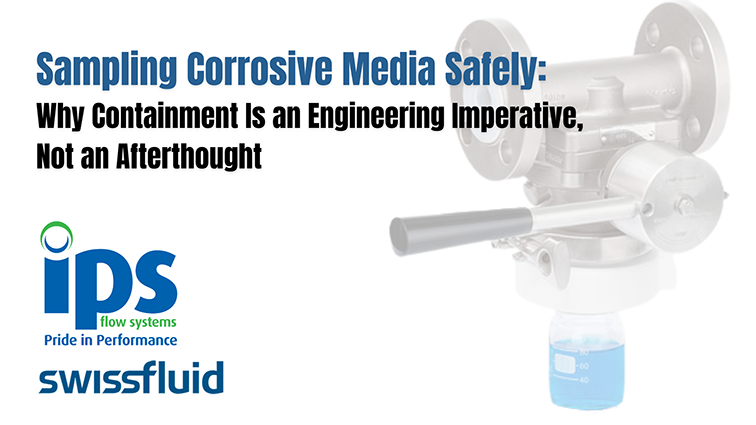
Sampling Corrosive Media Safely:
Why Containment Is an Engineering Imperative, Not an Afterthought
Sampling is routinely treated as one of the most mundane interactions in industrial process management. In practice, it is one of the highest-risk. It is the point at which the process meets the person, where the boundary between controlled system and human operator is at its most exposed. In corrosive media environments, that exposure carries consequences that ripple across operational safety, system integrity, regulatory compliance, and long-term cost.
The evidence from UK industry is clear. According to the Health and Safety Executive (HSE), work-related injuries and ill health from current working conditions cost the UK economy an estimated £22.9 billion in 2023/24 [1]. Across all industries, 40.1 million working days were lost in 2024/25 due to work-related illness and workplace injury [2]. Exposure to hazardous substances, including corrosive chemicals, remains one of the most persistent contributors to this burden, and one of the most preventable.
The question is not whether the risk is understood. It is whether the engineering response matches the scale of that understanding.
The most effective way to reduce risk is to remove it at the point of design, not manage it downstream through procedure and personal protective equipment.
Where Sampling Systems Continue to Fail
Despite decades of legislative framework, including the Control of Substances Hazardous to Health Regulations 2002 (COSHH), which legally requires employers to prevent or adequately control exposure to hazardous substances [3], the same design failures surface across industrial facilities with striking regularity.
Open sampling methods. Poorly positioned take-off points. Dead volumes within the system. Inadequate material selection. These are not fringe occurrences, they are structural problems embedded in systems that were often designed without sufficient attention to the sampling interaction itself.
The consequences are well documented at a sector level. The HSE's 2024/25 statistics confirm that workplace exposure to hazardous substances continues to drive significant acute and long-term ill health across UK industry [4]. In manufacturing, one of the primary sectors where corrosive media is routinely handled, chemical exposure remains a leading cause of occupational injury [2].
The regulatory framework is unambiguous. COSHH requires that exposure be prevented where possible, and where it cannot be prevented, adequately controlled. The hierarchy of control is explicit: engineering controls must take precedence over administrative measures and personal protective equipment [3]. And yet, the industry response too often inverts this hierarchy, designing inadequate systems, then compensating through procedure and PPE.
Poorly designed sampling systems frequently lead to compounding inefficiencies and maintenance challenges that are far more costly to resolve once installed. The time to address these risks is before commissioning, not after the first incident.
Why Corrosive Media Changes the Risk Profile Entirely
Corrosive chemicals do not simply add risk to a poorly designed system, they amplify every existing weakness within it. Any exposure point becomes a potential injury site. Any material incompatibility becomes a failure risk. Any inconsistency in sampling procedure introduces variability that affects both operator safety and process quality.
In these environments, there is no viable margin for improvised solutions. The system must be designed to maintain full containment of the process at every stage of the sampling interaction, from initial valve actuation through to sample collection and system reset.
The long-term consequences of inadequate chemical exposure controls are well evidenced at the national level. The HSE estimates that approximately 12,000 deaths each year in Great Britain are linked to past occupational exposure to hazardous substances [5]. While many of these are attributable to legacy asbestos exposure, they illustrate the trajectory of harm that flows from inadequate exposure management, harm that manifests years, or decades, after the original failure of engineering control.
For operators working with corrosive media today, that long-term lens matters. The decisions made at system design stage, about materials, containment, valve specification, and sampling arrangement, are decisions that carry consequences well beyond the immediate operational window.
Containment is not a feature to be added where budget allows. In corrosive media environments, it is the baseline requirement from which all other design decisions must follow.
The Case for Engineered Safety
Too often, sampling safety is addressed primarily through procedure: training programmes, PPE protocols, operational guidance, permit-to-work systems. All of these have value. None of them should be the primary line of defence.
The HSE's own hierarchy of control places elimination and substitution at the apex, followed by engineering controls, before reaching administrative measures and PPE [3]. The practical implication for sampling system design is straightforward: if the system can be designed to prevent operator exposure in the first place, that outcome is always preferable to managing exposure risk after the fact.
Closed sampling systems represent the engineering application of this principle. Rather than relying on the operator to manage the exposure interaction, they are designed to:
- Control the movement of corrosive media throughout the sampling sequence
- Prevent unnecessary operator exposure at every stage
- Maintain process consistency and sample integrity across repeated operations
- Integrate with the wider pipeline without creating dead volumes or retrofitted weak points
This is not a subtle distinction. A system designed with containment as its governing principle behaves differently under operational stress, under maintenance pressure, and under the conditions that real industrial environments routinely produce. It does not depend on the operator making the right decision under pressure. It is engineered to produce the right outcome by default.
Design Factors That Determine System Performance
Safe and reliable sampling in corrosive environments is not the product of any single component, it is the outcome of an integrated design approach in which multiple factors are addressed coherently and without compromise.
Controlled Actuation
Safety handles and engineered actuation mechanisms ensure that sampling can be carried out in a controlled, repeatable manner that minimises the reliance on manual handling and operator judgement. Consistency of operation is itself a safety outcome.
Material Compatibility
Valve bodies, seals, and associated components must be specified for compatibility with the specific corrosive media being handled, including consideration of temperature, pressure, and concentration across the full operating range. Material selection is not a catalogue exercise; it is an engineering decision with direct safety implications.
System Integration
Sampling points must be properly integrated into the pipeline architecture, whether in horizontal or vertical orientation, rather than retrofitted as secondary considerations. Integration determines whether a sampling system performs as intended under real operating conditions, or introduces the vulnerabilities that characterise afterthought design.
Closed Containment Arrangements
Enclosed sampling systems, including cabinet arrangements where the application demands it, eliminate the exposure pathways that open sampling creates. The process remains contained; the operator remains protected. This is the foundational principle from which all other design decisions should follow.
Emissions Control
In demanding applications, sealed valve designs and robust construction provide an additional layer of security beyond primary containment. Where the consequences of any release are significant, the system must be designed with redundancy in its containment assurance.
The Long-Term Operational Argument
The business case for engineered sampling containment extends well beyond immediate safety outcomes. Poorly designed systems impose a compounding operational cost: heightened maintenance burden, unplanned downtime, elevated regulatory scrutiny, and the costs, direct and indirect, associated with incidents.
The scale of these costs at the national level is instructive. The HSE estimates the total annual cost of workplace injury and ill health from current working conditions at £22.9 billion for 2023/24 [1]. Even a fraction of that exposure, attributable to preventable failures in process system design, represents a significant operational liability for the businesses involved.
Sampling systems are not temporary installations. They are part of the permanent infrastructure of a process facility. When they are designed correctly, with containment engineered in from the outset, they deliver reliable, repeatable sampling performance across their operational life, in conditions that would expose the weaknesses of a less rigorously designed system. When they are designed poorly, those weaknesses compound over time.
The choice between these outcomes is made at the design stage. That is where the engineering response must be equal to the risk.
The £22.9 billion annual cost of workplace injury and ill health to the UK economy is not an abstraction. It is the aggregate of thousands of individual engineering decisions that did not adequately prioritise risk elimination at source.
Conclusion
Sampling is among the smallest physical touchpoints in a process system and among the most consequential. In corrosive media environments, the difference between a system that is genuinely safe and one that merely appears compliant is determined by a single principle: containment, not added under time or budget pressure, not improvised on site, but designed in with rigour from the very first stage of the project.
The regulatory framework demands it. The evidence from UK industry demonstrates the consequences of falling short. And the engineering capability to deliver it, through closed systems, compatible materials, integrated design, and controlled actuation, is well established.
The standard, for any operator handling corrosive media, should be nothing less.
References
1. Health and Safety Executive (HSE). Costs of Injuries and Ill Health 2024/25. HSE Statistics. Available at: https://www.hse.gov.uk/statistics/
2. Health and Safety Executive (HSE). Key Figures for Great Britain 2024 to 2025. HSE Statistics Overview. Available at: https://www.hse.gov.uk/statistics/overview.htm
3. Health and Safety Executive (HSE). Control of Substances Hazardous to Health Regulations 2002 (COSHH). Available at: https://www.hse.gov.uk/coshh/law.htm
4. Veriforce CHAS. HSE Health and Safety Statistics 2025. Available at: https://www.chas.co.uk/blog/hse-statistics-2025/
5. Health and Safety Executive (HSE) / SafeWorkforce. Key Insights from the HSE 2023/24 Safety Report, citing HSE occupational disease burden estimates. Available at: https://www.joinsafeworkforce.com/insights/blog/key-insights-from-hse-2023-24-safety-report/
6. UKATA. HSE Publishes Annual Work-Related Ill Health and Injury Statistics for 2023/24. Available at: https://www.ukata.org.uk/news/hse-publishes-annual-work-related-ill-health-and-injury-statistics-202324/