
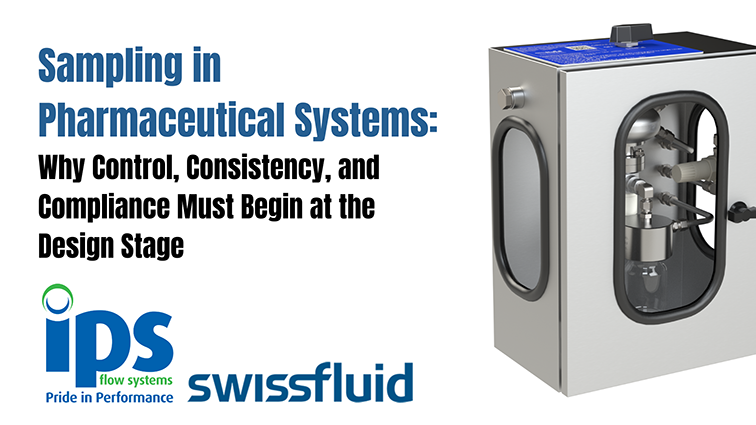
Sampling in Pharmaceutical Systems:
Why Control, Consistency, and Compliance Must Begin at the Design Stage
The UK life sciences sector generated £146.9 billion in turnover in 2023/24, employing 359,600 people across 7,320 companies [1]. Biopharmaceutical companies alone accounted for £98.9 billion of that total. These are not abstract figures. They represent a sector in which the quality, safety, and reliability of every manufacturing process carries direct consequences, not only for commercial performance, but for patient outcomes.
Within that context, sampling is not a peripheral activity. It is one of the most consequential interactions in the entire manufacturing process. Every sample taken is a direct engagement with the product under development or in production. Every inconsistency in how that sample is collected introduces variability into data that must be trusted, defended, and ultimately relied upon by regulators, quality teams, and patients.
And yet, sampling is still too frequently designed as an afterthought, fitted around existing pipework, accommodated where space permits, and addressed through procedure rather than engineering. In pharmaceutical environments operating under Good Manufacturing Practice, that approach is not just suboptimal. It is a liability.
In pharmaceutical manufacturing, quality is not an output to be inspected at the end of the process. It must be engineered into the process from the beginning. Sampling is no exception.
The Regulatory Framework Sets the Standard
Good Manufacturing Practice, as enforced in the UK by the Medicines and Healthcare products Regulatory Agency (MHRA), establishes a clear and unambiguous expectation: pharmaceutical manufacturing processes must be consistently controlled, fully documented, and capable of producing products that meet their defined specifications, batch after batch [2].
The MHRA completed 353 GMP inspections in 2024/25, a figure that reflects the intensity of regulatory oversight now facing UK pharmaceutical manufacturers [3]. Inspection findings consistently identify failures in process control, documentation, and contamination prevention as the primary sources of non-compliance. Sampling systems, as a direct interface between the operator and the process, sit at the intersection of all three.
The regulatory standard is not simply that samples are taken. It is that samples are taken in a way that is controlled, repeatable, and demonstrably consistent with the validated process. A sampling system that introduces variability, requires excessive operator intervention, or creates contamination risk does not meet that standard regardless of how well it is procedurally managed. The MHRA's inspection programme exists precisely to identify the gap between procedural intent and engineering reality.
Where Pharmaceutical Sampling Systems Fail
The failure modes in pharmaceutical sampling are well established, and they recur across facilities and manufacturing contexts with striking consistency.
Sampling points introduced late in the design process are typically positioned for access convenience rather than process alignment. They create dead volumes in which product can stagnate between samples. They generate variability between sampling events that cannot be controlled through operator training alone. They require levels of manual handling that increase both contamination risk and the potential for operator error.
The consequences extend beyond individual sampling events. In a GMP environment, sampling data forms part of the validated process record. If the sampling method cannot be shown to be consistent and controlled, the data it generates cannot be fully relied upon. Batch release decisions, trend analyses, and out-of-specification investigations all depend on sampling data that is genuinely representative of the process. When the sampling system itself is a source of variability, the entire data picture is compromised.
This is the fundamental problem with treating sampling as an operational task to be managed through procedure. Procedure can describe how a sample should be taken. It cannot compensate for a system that is not designed to support controlled, repeatable sampling in the first place.
The MHRA's inspection programme does not evaluate whether procedures exist. It evaluates whether those procedures reflect engineering reality. A well-written sampling procedure applied to a poorly designed system will not satisfy a GMP inspector.
Control Is an Engineering Outcome, Not a Procedural One
The most effective pharmaceutical sampling processes share a defining characteristic: control is built into the system, not applied on top of it. Inline sampling configurations that integrate directly into the pipeline allow samples to be taken under defined, stable conditions, with minimal disruption to the main process and without introducing variability through operator-dependent actions.
This matters for several interconnected reasons. First, it removes the operator as a variable in the sampling process. When the sampling sequence is engineered to be consistent, the result does not depend on who carries it out, under what time pressure, or with what level of experience. Second, it protects the integrity of the sample itself. Product collected under controlled conditions, from a system that maintains consistent flow and pressure at the sampling point, is representative of the process in a way that a manually extracted sample cannot reliably be. Third, it supports the validation requirement that sits at the core of GMP compliance. A sampling system that behaves consistently and predictably can be validated. One that depends on manual technique and operator judgement cannot.
The shift from procedural sampling to engineered sampling is a shift from managing risk to eliminating it at source. That distinction carries significant weight in any GMP inspection, and it carries even greater weight when the data generated by sampling is called upon to support a batch release decision or regulatory submission.
Consistency Is What Makes Pharmaceutical Data Meaningful
In pharmaceutical operations, the value of any analytical result is only as good as the sampling process that generated it. If sampling conditions vary between events, the resulting data cannot be meaningfully compared. If operator involvement introduces inconsistency, trend analysis becomes unreliable. If the process is disrupted by the act of sampling, the sample may not represent the process at all.
These are not theoretical concerns. They manifest as out-of-specification results that cannot be explained, as batch-to-batch variation that obscures genuine process signals, and as regulatory findings that identify sampling methodology as a root cause of data integrity issues. Data integrity remains one of the most frequently cited concerns in pharmaceutical GMP inspections globally, with issues related to data reliability cited in nearly a third of regulatory authority inspections [4].
Well-engineered sampling systems address this directly. When each sample is taken under the same conditions, with the same flow characteristics, from the same representative point in the process, the data it generates is genuinely comparable. It can support trend analysis with confidence. It can be relied upon in out-of-specification investigations. It can form the evidentiary basis for batch release decisions and regulatory submissions. Consistency in sampling is not a quality of life improvement. It is a prerequisite for meaningful pharmaceutical data.
Contamination Prevention Cannot Be Procedural
Contamination control is a central pillar of GMP compliance, and it is one of the areas where sampling system design has the most direct impact. Every time a pharmaceutical system is opened for manual sampling, the risk of introducing external contamination increases. This applies not only to microbiological contamination but to particulate matter, cross-contamination between products, and environmental variables that affect the integrity of the sample and the process.
Closed inline sampling systems address this risk at the engineering level. The process remains sealed. The sample is collected without exposing the product to the surrounding environment. The operator interaction is controlled and repeatable rather than open and variable. This is the approach that GMP frameworks consistently point towards: prevention of contamination through design, not mitigation through procedure.
The practical implications for batch rejection risk are significant. In a sector where a single contamination event can result in the loss of an entire batch, and where batch rejection rates carry direct financial and supply chain consequences, the investment in contamination-preventive sampling design is not an optional enhancement. It is a risk management decision with a clear and quantifiable return.
A sampling system that requires the product to be exposed to achieve a sample is not a controlled sampling system. In pharmaceutical manufacturing, containment and control are not separate design objectives. They are the same objective.
Compliance Is the Result of Good Design, Not a Target in Itself
Regulatory compliance is a non-negotiable feature of pharmaceutical manufacturing in the UK. The MHRA's inspection programme, aligned with EU GMP and the Pharmaceutical Inspection Co-operation Scheme, maintains a standard that demands consistent, documented, and controlled manufacturing processes across every stage of production [2].
However, compliance that is pursued as an end in itself, through procedural overlays and retrospective documentation of inadequate systems, is both fragile and expensive to maintain. It creates the conditions for repeated inspection findings, corrective action programmes, and the ongoing operational burden of managing non-conformances that trace back to design decisions that were never properly addressed.
The more durable and commercially efficient approach is to design sampling systems that are inherently compliant: integrated into the process, controlled by engineering rather than operator technique, and capable of producing consistent, representative data that can be relied upon across the manufacturing lifecycle. When sampling is designed to this standard, compliance follows as a natural consequence of good engineering rather than as a target to be pursued through additional procedural complexity.
This is the standard that the UK pharmaceutical sector's scale and global standing demand. A sector generating £98.9 billion in biopharmaceutical turnover annually, and exporting pharmaceutical products worth £41.2 billion in 2024 [5], cannot afford the reputational and commercial consequences of quality failures that originate in sampling systems that were never designed to meet the demands placed upon them.
Sampling as a Process Component, Not a Process Interruption
There is a meaningful distinction between a sampling system that is added to a process and one that is part of it. The former interrupts the process to extract information. The latter operates continuously within it, providing representative data without disruption, under conditions that are consistent with the validated manufacturing environment.
This distinction matters beyond the immediate operational context. Pharmaceutical manufacturing is moving towards greater process analytical technology adoption, continuous manufacturing models, and real-time release testing frameworks that depend on sampling data of unimpeachable quality. The sampling infrastructure that supports these advanced approaches must itself be advanced: inline, closed, controlled, and capable of meeting the data quality requirements that modern pharmaceutical manufacturing now demands.
Sampling points designed to meet the minimum requirements of a conventional manufacturing setup will not support this trajectory. The investment case for sampling system design that reflects the full demands of the GMP environment, and the direction of travel within UK pharmaceutical manufacturing, is clear and well-founded.
Conclusion
The UK pharmaceutical sector operates at the intersection of scientific excellence, commercial ambition, and some of the most rigorous regulatory oversight in the world. Every system within a GMP manufacturing environment must be capable of consistently meeting the standard that intersection demands.
Sampling is not exempt from that requirement. It is subject to it in full. The design decisions made about sampling points, inline configurations, containment, operator interaction, and process integration are not secondary engineering considerations. They are primary quality decisions that determine whether sampling data can be trusted, whether contamination risk is controlled, and whether the overall manufacturing process is genuinely compliant or merely procedurally described as such.
The MHRA inspects to that standard. The pharmaceutical data record depends on it. And the patients whose health outcomes rest on the quality of medicines manufactured in UK facilities deserve nothing less.
References
1. Department for Science, Innovation and Technology / Office for Life Sciences. Bioscience and Health Technology Sector Statistics 2023 to 2024. GOV.UK, 2025. Available at: https://www.gov.uk/government/statistics/bioscience-and-health-technology-sector-statistics-2023-to-2024
2. Medicines and Healthcare products Regulatory Agency (MHRA). Good Manufacturing Practice and Good Distribution Practice. GOV.UK, updated May 2024. Available at: https://www.gov.uk/guidance/good-manufacturing-practice-and-good-distribution-practice
3. Pharmuni / GMP Regulatory Guidance. GMP in UK Guide 2026. Available at: https://pharmuni.com/2025/12/17/gmp-in-uk-guide/ (citing MHRA inspection completion data for 2024/25)
4. PharmaLane UK. GMP Compliance Challenges to the Pharma Industry, 2025. Available at: https://www.pharmalaneuk.com/articles/gmp-compliance-challenges-to-the-pharma-industry-2025/ (citing data integrity citation rates across regulatory authority inspections)
5. Association of the British Pharmaceutical Industry (ABPI) / Clinical Trials Arena. UK Pharma Industry: Investment and Export Data, 2024/25. Available at: https://www.clinicaltrialsarena.com/news/uk-pharma-industry-risks-losing-world-leading-status-as-investment-plummets/