Wastewater dosing pipework: why containment should come before material selection
Dosing lines are often small. The consequences of getting them wrong rarely are.
A chemical dosing run might be only a short section of pipework feeding a treatment process, a neutralisation stage or a single dosing point. That is exactly why it gets treated as routine: match the last material, match the size, order the fittings and move on.
That approach can create problems.
In wastewater applications, risk is not defined by pipe diameter. It is defined by what is being dosed, at what concentration, at what temperature and pressure, along what route, with what access for maintenance, and by one further question that is easy to skip: what would happen if the line leaked.
That is why containment should be discussed before material selection, not after.
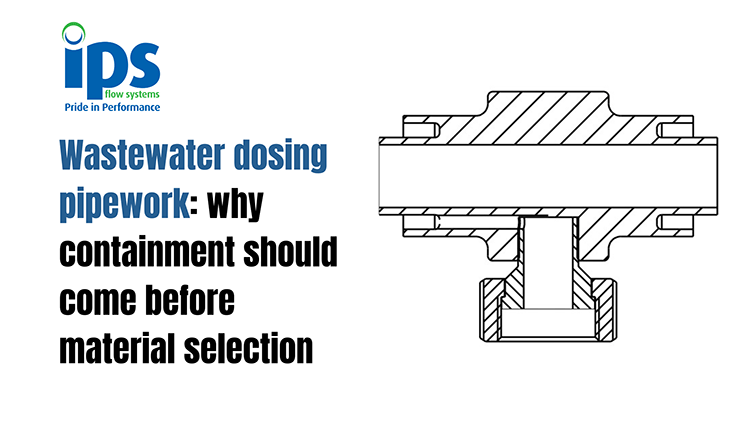
IPS documentation sets out double containment systems for transporting dangerous fluids, protecting groundwater and handling hazardous products, with carrier and containment options across PVC-U, PVC-C, PE, PP and PVDF. DuoSafe® FLEX is identified specifically for dosing applications.
Industry context
Wastewater sites depend on chemical dosing for process control, treatment performance and compliance. Dosing systems handle chemicals used for pH correction, disinfection, odour control, coagulation, cleaning and process adjustment.
They rarely operate in easy environments. Routes are congested. Pipework passes through walkways, bunded areas, kiosks, chemical storage zones, service trenches and plant rooms. Maintenance teams work around those lines during routine checks, pump changes and emergency repairs.
The pipework is often not the most expensive part of the system. It can be one of the most disruptive if it fails.
A leak from a dosing line can mean safety concerns, unplanned downtime, chemical exposure, environmental risk, contamination of nearby services and emergency replacement. It also raises questions that are uncomfortable after the event: was the material compatible, was secondary containment considered, was the route suitable, could the leak have been detected or controlled sooner?
The commercial tension is clear. Choosing pipework on product price alone looks efficient at procurement stage. It becomes expensive if it leads to rework, maintenance exposure or a shortened service life.
The problem with “same as last time”
Like-for-like replacement is sensible when the duty is unchanged and the original system has performed well. Wastewater dosing duties are not always static.
Concentrations change. Dosing rates are altered. A site moves to a different supplier chemical. Temperature assumptions turn out to be wrong. Pumps are upgraded. A route is extended. What suited one duty may not suit the next.
This is where material selection is often misunderstood. The first question should not be: PVC-U, PVC-C, PE, PP or PVDF? The first question should be: what risk are we trying to control?
Once the risk is understood, the material conversation becomes more useful. A compatible chemical moving through a low-risk, accessible area does not need the same containment strategy as an aggressive medium running through a sensitive or hard-to-reach route.
Containment is part of that decision. It is not an add-on reserved for large chemical systems. For many dosing applications, secondary containment is what manages the consequences of a leak.
Why containment should come first
Material compatibility matters, but it is only one part of the specification.
A carrier pipe may be chemically suitable. The joints may be appropriate. The pressure and temperature ratings may be correct. If the line runs above critical equipment, through an access area, or across a location where leakage would create a serious problem, the specification is still incomplete.
Containment forces the team to look past normal operation and ask what happens during failure. That shift is the point.
A sound dosing line specification should answer:
• What chemical is being carried, and at what concentration?
• What are the operating and maximum temperatures?
• What pressure will the system see, including pump pressure and surge?
• Where is the pipe routed?
• Can the line be inspected, isolated and maintained safely?
• Would a leak create safety, environmental, contamination or downtime issues?
• Does the system need secondary containment from the start?
These questions help engineers, consultants, contractors and maintenance teams decide well before product selection begins.
Practical considerations before ordering
1. Chemical compatibility
Do not rely on material names. Compatibility depends on the exact chemical, concentration, temperature and exposure conditions.
PVC-U offers excellent resistance to many acids, bases and salt solutions across a 0°C to 60°C working range, but it is not resistant to aromatic and chlorinated hydrocarbons. PVC-C raises temperature capability to 100°C and resists many inorganic chemicals, though the specific duty still needs checking. PP offers excellent resistance to many acids, alkalis and salts. PVDF covers aggressive or highly specialised applications across a wide temperature range.
2. Jointing method
Joint integrity is central to reliability. Some materials are solvent cement jointed, others require heat fusion welding. IPS documentation notes that PVC-U, PVC-C and ABS can be joined by cold solvent welding, while PP, PE and PVDF need heat welding because of their resistance to most organic solvents. Welding equipment is available for sale or hire, with installation guidance and training where required. Select the method around material, access, installer competence and site conditions.
3. Secondary containment
Double containment should be discussed where a line carries hazardous or aggressive fluids, where leakage could affect personnel, groundwater, nearby services or plant operation, or where access for inspection is limited. IPS environmental product information identifies double containment systems for hazardous products, dangerous fluids, groundwater protection and above or below ground applications, and notes DuoSafe® FLEX for dosing. Containment is a design decision, not a late-stage upgrade.
4. Flow control and monitoring
Dosing systems often need more than pipe and fittings. Flow measurement, valves, dosing valves, pressure control, sampling points or analytical equipment may be required. IPS documentation highlights flow measurement and analytical controls for chemical dosing and water and wastewater treatment. Getting these right improves control, maintenance access and confidence in the system.
5. Support and installation
Plastic pipework is lightweight and practical, but it still needs correct support, allowance for thermal movement and proper installation tools. Poor support puts stress into joints, creates alignment problems and shortens system life. That matters most where pipework runs above ground, around existing plant, or through areas subject to vibration, temperature variation or regular maintenance.
Where IPS adds value
IPS supports wastewater dosing projects by helping customers decide well before pipework is ordered. That support includes material selection guidance, compatibility checks, dual containment options, valves, flow control products, installation tools, welding equipment support and practical advice for contractors and maintenance teams.
For buyers, the value is not only product supply: it is reducing the risk of ordering the wrong system. For engineers and consultants, it is specification clarity. For contractors, it is installable advice before the site team is under pressure. For maintenance teams, it is fewer surprises when a line needs inspection, isolation or replacement.
Where repeat ordering is required, the IPS E-Commerce Platform supports efficient reordering once the correct system has been selected.
Conclusion
Wastewater dosing pipework should not be treated as a minor line item. The pipe may be small, but the duty can be demanding. The safest and most cost-effective decisions are made when containment, compatibility, installation and maintenance access are considered together.
Before specifying the material, ask three things: what the line is carrying, where it is going, and what would happen if it leaked. Then choose the pipework system.
Speak to IPS before specifying. Send the chemical, concentration, temperature, pressure, route and containment requirements to the technical team, and the application can be reviewed before installation.
Download our free pre-order check-list today: https://fliphtml5.com/download/downloading.html?bookId=77455827&type=1&title=dosing-line-pre-order-checklist